



Use Case
SharePoint Records Management: A Complete Guide
Manage records—including email—across SharePoint and Microsoft 365 to support compliance, retention, and audit requirements.


Effective SharePoint records management in Microsoft 365 requires consistent capture, classification, and retention of documents and email across systems. Many organizations face compliance risks because critical communications remain fragmented or unmanaged. Colligo helps centralize records in SharePoint by capturing email and documents directly from Outlook, improving governance, consistency, and audit readiness.
On This Page:
- SharePoint Records Management: A Complete Guide
- What is SharePoint Records Management?
- Why Records Management in Microsoft 365 is Challenging
- The Role of Email in Records Management
- Key Elements of an Effective Records Management Program
- Records Management for Regulated Industries
- How Colligo Supports SharePoint Records Management
- Best Practices for SharePoint Records Management
What is SharePoint Records Management?
SharePoint records management is the process of capturing, classifying, retaining, and disposing of records within Microsoft 365.
Records include:
- Documents
- Emails
- Attachments
- Communication history
- Regulatory and operational content
The goal is to ensure:
- Records are complete and accurate
- Retention policies are consistently applied
- Information is accessible for audits, discovery, and reporting

Why Records Management in Microsoft 365 is Challenging
While Microsoft 365 provides powerful tools, organizations often struggle to implement effective records management in practice.
Common challenges include:
- Email is not properly captured as a record
Critical communications remain in inboxes instead of being managed as records. - In-place records management creates compliance gaps
Leaving records in their original location makes it difficult to enforce governance and retention consistently. - Retention policies rely on user behavior
Manual classification leads to inconsistent application of policies. - Records are fragmented across systems
SharePoint, Outlook, Teams, and file shares create disconnected records. - Audit and eDiscovery readiness is limited
Incomplete or poorly structured records slow down investigations and increase risk.
The Role of Email in Records Management
Email is one of the most important—and most overlooked—sources of records. It contains:
- Decisions
- Approvals
- Client and stakeholder communication
- Supporting documentation (attachments)
Without proper capture:
- records are incomplete
- compliance risk increases
Why email must be part of your records strategy:
- Email often contains the official version of events
- Attachments represent key supporting documents
- Regulatory requirements frequently include email retention

Key Elements of an Effective Records Management Program
A strong records management program goes beyond technology—it requires structure, governance, and consistency.
Core elements include:
- Clear classification and taxonomy
Records must be organized in a way that reflects business and regulatory needs. - Retention and disposition policies
Define how long records are kept and when they are disposed. - Centralized system of record
SharePoint acts as a controlled environment for storing records. - Automated capture and classification
Reduce reliance on manual processes. - Auditability and defensibility
Maintain complete, traceable records across their lifecycle.
Records Management for Regulated Industries
Different industries face unique records management requirements—but share common challenges around email and compliance. Examples include:
- Government
FOI requests, retention schedules, and public records requirements → M-19-21 electronic records management basics - Oil & Gas
Operational records, safety documentation, and regulatory compliance → Oil and gas records management - Financial Services, Healthcare, and Legal
Strict compliance requirements tied to communication and documentation

How Colligo Supports SharePoint Records Management
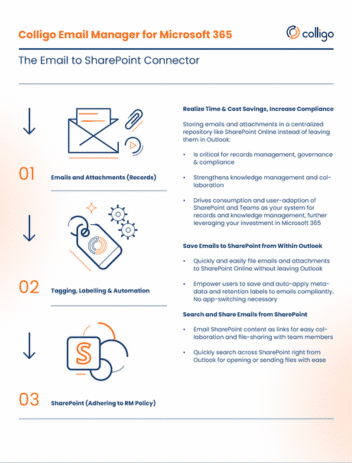
Colligo helps organizations manage records in Microsoft 365 by ensuring that email and documents are captured, classified, and stored correctly.
- Capture email records directly from Outlook
Ensure communications are stored as part of the official record - Preserve attachments and supporting documents
Maintain complete, defensible records - Store records in SharePoint as the system of record
Apply metadata, retention, and governance policies - Improve classification and consistency
Reduce reliance on manual user behavior - Support audit, compliance, and eDiscovery
Quickly locate and retrieve complete records
Best Practices for SharePoint Records Management
To improve records management in Microsoft 365:
- Treat email as a first-class record
- Avoid relying solely on in-place management
- Use SharePoint as a centralized system of record
- Apply consistent classification and retention policies
- Reduce friction to improve user adoption
- Ensure records are complete, not fragmented
- Simplify email capture with integrated tools – Use a solution like Colligo Email Manager to connect Outlook and SharePoint, making it easier for users to file emails and maintain complete records

Improve records management in Microsoft 365
Book a demo to see how Colligo helps organizations capture, manage, and govern records across SharePoint and Outlook.

Rave Reviews
“Colligo was able to institutionalize our research process… and help our firm effectively create a full records management system.”
Investment Professional
Leading Canadian Asset Manager
“I can also rest easy knowing we are archiving our emails in accordance with Quebec Law Society regulations.”
Pierre Matte
Director of Corporate & Legal Services, L. Fournier & Fils Inc.
“Colligo was the missing link in providing our client with an end-to-end electronic records and information management solution. With it, we delivered! Colligo solves the problem of classifying and properly managing case-based emails while increasing user adoption. My client was extremely happy with the solution because it got the job done and was easily adopted by the end users.”
Amina Elgouacem
CEO, NEOSTEK
Related Records Management Resources

–
Why In-Place Records Management is Not Compliant
Get clear on why in-place records management is not compliant & learn why a centralized model is your best choice for business success.

–
Email Compliance Simplified – Proactive Steps for Regulated Businesses
A webinar with practical solutions for ensuring your organization’s email handling is fully compliant with industry regulations.
–
How to Make Email Records Management Easy with ‘Auto-File’
We’ve got great news for you. Email ‘auto-file’ is here! Join us to see what makes this leading-edge, one-of-a-kind tool special.